Why Card Counting Dies at the Baccarat Table — And What Disciplined Players Do Instead
The Borrowed Playbook That Doesn't Travel Well
Blackjack card counting is one of the most romanticized skills in American casino culture. From MIT teams to Hollywood films, the image of the sharp-eyed player keeping a silent mental tally has taken on near-mythological status. It is understandable, then, that players new to baccarat attempt to import the same framework. The logic seems sound on the surface: both games use standard decks, both involve cards dealt from a shoe, and both offer outcomes shaped by the composition of that shoe. Surely the same analytical lever should work in both rooms.
It does not. And the reasons why are specific, structural, and worth understanding in detail before you sit down with real money at stake.
The Mechanics of Why Counting Fails in Baccarat
In blackjack, card counting works because the player's decisions — hit, stand, double, split — are directly influenced by the cards remaining in the shoe. A deck rich in tens and aces genuinely favors the player, and a skilled counter can raise their bets at precisely those moments. The edge is real because the player's choices interact with the shoe composition in a meaningful way.
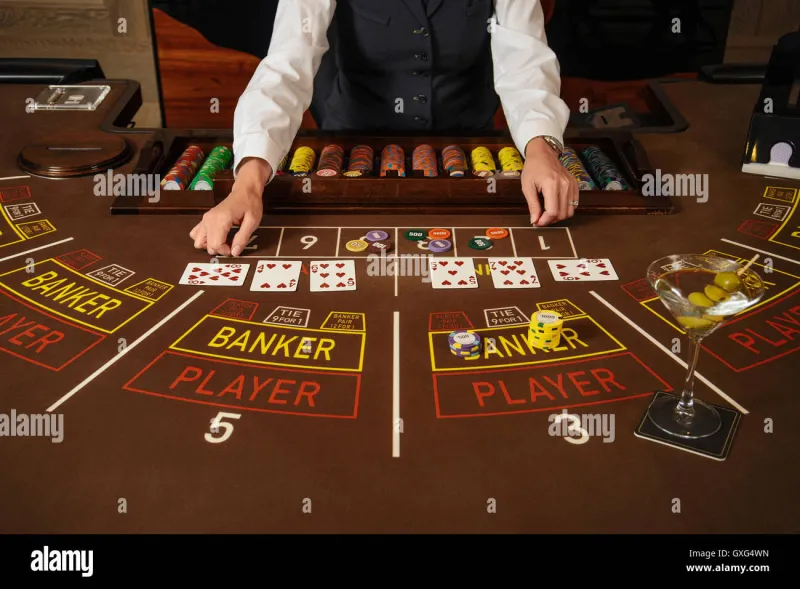
Baccarat removes that interaction almost entirely. The drawing rules for both the Player hand and the Banker hand are fixed by a rigid tableau that neither you nor the dealer controls. There is no decision point where you can exploit a favorable count by altering your play mid-hand. The cards will be drawn or not drawn according to a predetermined ruleset regardless of what you know about the shoe.
Researchers have examined this question rigorously. The academic consensus, reinforced by studies conducted by figures such as statistician Peter Griffin, is that even under ideal conditions — a freshly opened eight-deck shoe dealt all the way to the end — the maximum theoretical edge a card counter could extract from baccarat is so small it is functionally irrelevant. We are talking about fractions of a fraction of a percent, achievable only in the final hands before a shuffle, and only under conditions that virtually no American casino permits.
The Shuffle Point Problem
That last qualifier matters enormously. Even if you were willing to invest the effort to track cards through an eight-deck shoe, most U.S. casinos insert the cut card at roughly the 50 to 75 percent penetration mark. The shoe is reshuffled well before you ever reach the theoretically advantageous territory near the end. In practice, any marginal counting edge evaporates before it can be realized.
Furthermore, a growing number of casino floors — particularly in larger properties across Las Vegas, Atlantic City, and regional gaming destinations — have introduced continuous shuffle machines at baccarat tables. These devices return discarded cards to the shoe after every round, eliminating the concept of shoe penetration altogether. There is no "end of shoe" to wait for. The deck composition resets with every deal. For a card counter, this is not a setback. It is a complete elimination of the premise.
What Skilled Players Actually Pay Attention To
None of this means that observation at the baccarat table is worthless. It means that the object of observation must shift. Players who perform consistently well over time are not tracking card values. They are tracking something far more actionable: their own behavior, their session structure, and the specific conditions of the table they have chosen to play.
Bet sizing relative to bankroll. Disciplined players treat every session as a finite resource allocation problem. They determine in advance what percentage of their session bankroll they are willing to place on any single hand, and they do not deviate from that structure regardless of how the shoe is running. This is not glamorous, but it is the single most impactful variable a player can control.
Commission structures and their compounding effect. In most U.S. casinos, the Banker bet carries a five percent commission on winning hands. Some properties, particularly those running no-commission or reduced-commission variants, alter this structure. A player who understands the mathematical difference between a standard five percent commission and a no-commission table paying even money on Banker wins — with the exception of a Banker-six outcome — is making an informed choice. That is genuine edge awareness, even if it is not counting.
Table minimums and session length. The relationship between minimum bet size, your available bankroll, and the length of time you intend to play is a strategic variable that many players ignore entirely. A table with a $25 minimum requires a meaningfully different bankroll cushion than a $10 minimum if you intend to survive normal variance across a two-hour session. Selecting the right table for your resources is an analytical decision, not a passive one.
Recognizing fatigue and tilt. This may be the most undervalued observational skill in casino play. The sharpest baccarat players are not watching the cards — they are watching themselves. Recognizing when emotional momentum from a losing streak is beginning to influence bet sizing, or when physical fatigue is degrading decision quality, is a form of in-session analysis that pays measurable dividends.
The Honest Edge in Baccarat
Baccarat is a negative-expectation game. No counting system, observational technique, or betting progression changes that fundamental reality. What disciplined play does accomplish is ensuring that you extract the maximum entertainment value from your bankroll while minimizing the rate at which the house edge erodes it.
The Banker bet, with its house edge of approximately 1.06 percent after commission, remains the most favorable wager on the standard baccarat layout. Playing it consistently, managing your session structure carefully, and resisting the pull of high-edge side bets is not a romantic strategy. It will not make for a compelling film. But it is the approach that the evidence actually supports.
Players who come to baccarat hoping to transplant a blackjack counting system are not wrong to want an edge — that instinct reflects serious intent. They are simply applying the right ambition to the wrong tool. The game rewards preparation, structure, and self-awareness. It does not reward a running count.
Understanding that distinction is where genuine baccarat education begins.