Choosing Your Battlefield: How Table Setup and Shoe Depth Shape Your Baccarat Odds
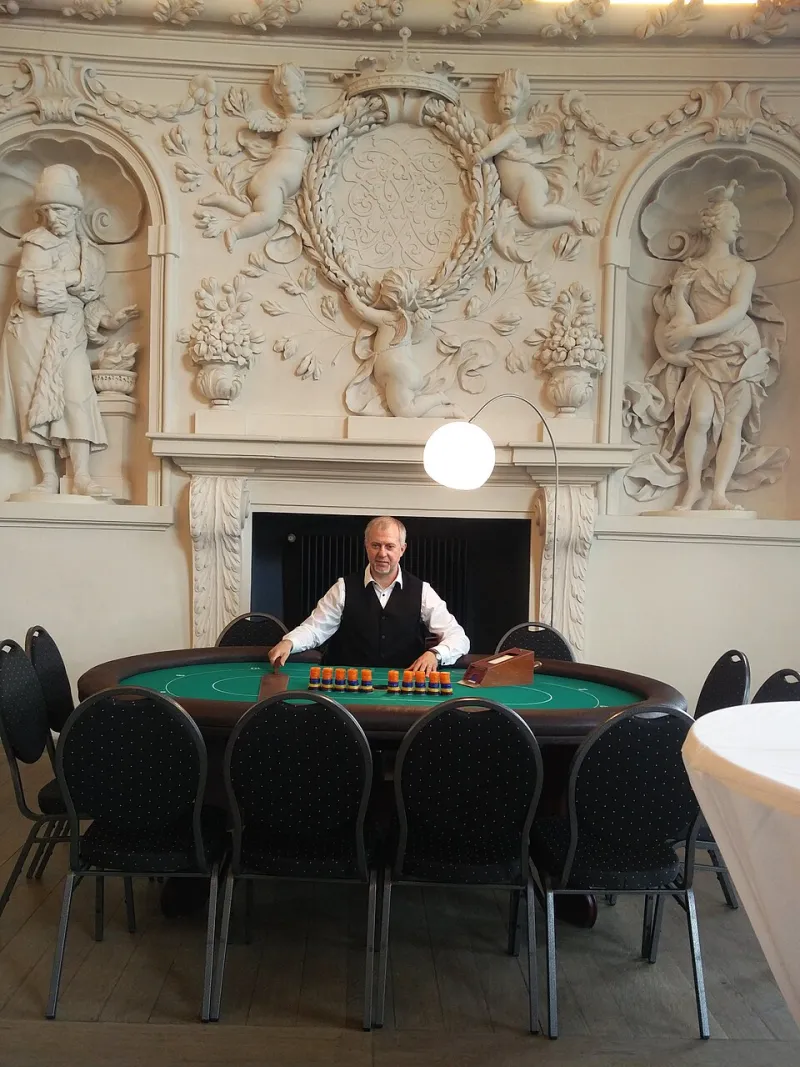
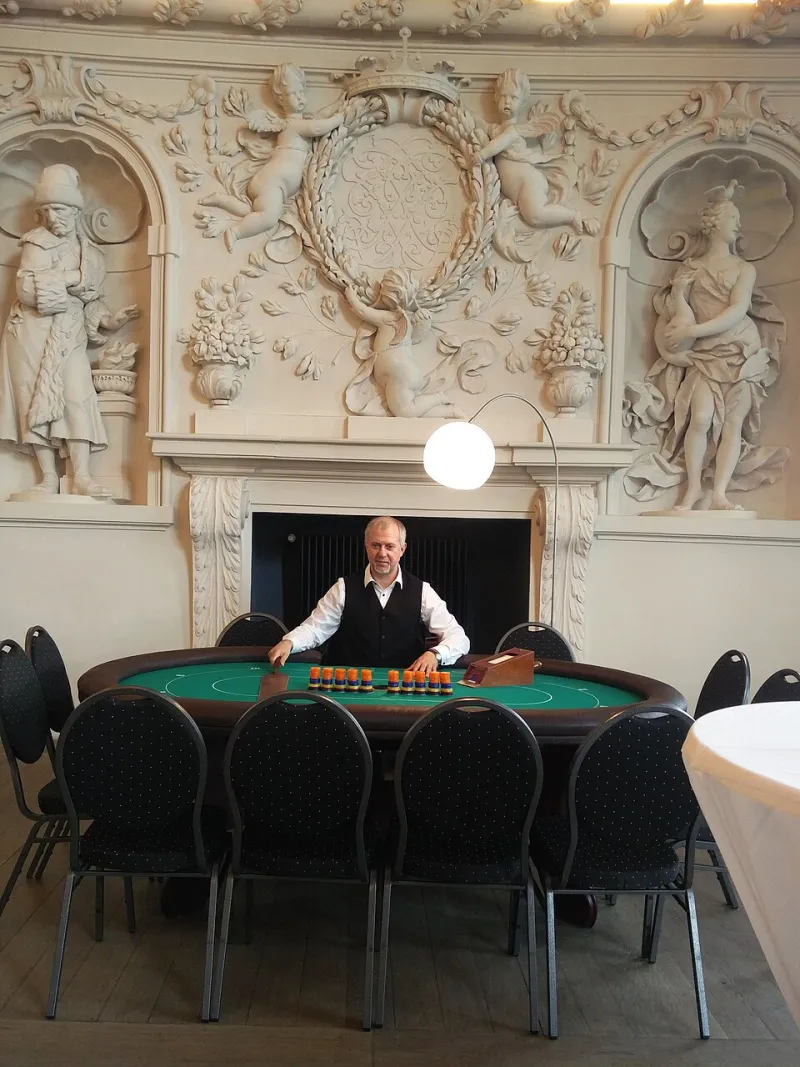
Photo: UdoPaul, CC BY-SA 4.0, via Wikimedia Commons
The Decision Before the Decision
Most baccarat players focus their strategic attention on what to bet—Banker, Player, or some combination thereof. That is a reasonable place to start. But there is an earlier decision that many players never consciously make: which table to sit at in the first place.
In a typical American casino, you may encounter several distinct baccarat formats on the same floor: a traditional full-size table with a six-deck shoe, a mini-baccarat setup dealing from an eight-deck shoe, and possibly a hand-shuffled game in the high-limit room. Online, the variation is even wider. Each of these games presents a subtly different mathematical environment. Understanding those differences allows you to make a more informed choice before a single card is dealt.
How the Number of Decks Affects Your Edge
Baccarat is one of the few casino card games where the number of decks in play has a quantifiable—though modest—effect on the house edge. Here is the breakdown across common configurations:
| Decks | House Edge on Banker | House Edge on Player |
|---|---|---|
| 1 | 1.01% | 1.29% |
| 6 | 1.06% | 1.24% |
| 8 | 1.06% | 1.24% |
The differences are small but real. A single-deck baccarat game is genuinely more favorable to the player on the Banker bet than an eight-deck shoe. However, single-deck baccarat is extraordinarily rare in US casinos and is almost never offered at standard table minimums. When you do encounter it, it typically comes with altered commission structures or side-bet requirements designed to compensate the house.
For most American players, the practical choice is between six-deck and eight-deck games. The mathematical difference between these two is negligible—roughly zero at the precision level that matters for recreational play. What matters more is the other structural variable: deck penetration.
Deck Penetration: The Overlooked Factor
Deck penetration refers to how deeply into the shoe the dealer deals before stopping to reshuffle. In an eight-deck shoe containing 416 cards, a casino might cut off anywhere from 52 to 104 cards at the back—meaning those cards will never be dealt in that shoe.
Why does this matter?
In games like blackjack, penetration is critical because deep dealing exposes more of the composition of the remaining shoe, enabling card counters to gain a meaningful edge. Baccarat is different: the game is not susceptible to card counting in any practically profitable way. Nonetheless, penetration still affects your session in two important respects.
First, it affects the number of hands per shoe. A deeply dealt eight-deck shoe might yield 70–80 hands before reshuffling. A shoe with aggressive cutting might yield only 55–60. Fewer hands per shoe means more frequent shuffles, which means more downtime and fewer opportunities to apply your betting strategy over a meaningful sample.
Second, it affects variance exposure. Shorter shoes produce fewer hands, which means each individual shoe represents a smaller sample. Your results will swing more dramatically between shoes, which can create the illusion of streaks or patterns where none statistically exist.
When evaluating a table, observe where the cut card is placed. A dealer who cuts deeply into the shoe—leaving only one deck or less behind the marker—is offering a more favorable playing environment in terms of session continuity.
Shoe Games vs. Hand-Shuffled Games
In some high-limit rooms and premium baccarat salons—particularly in properties catering to Asian-American clientele in markets like Las Vegas, Atlantic City, and Los Angeles—you may encounter hand-shuffled baccarat. These games are typically dealt from a smaller number of decks and involve elaborate shuffling rituals between shoes.
From a pure mathematical standpoint, the shuffling method does not change the underlying house edge. The cards carry the same probabilities regardless of how they were mixed. However, hand-shuffled games tend to be slower-paced, which has two practical consequences:
- Fewer hands per hour reduces your total expected loss in dollar terms, even if the percentage edge remains constant. A player losing 1.06% per hand on $100 bets loses less total money playing 30 hands per hour than 80 hands per hour.
- The ritualistic pace may encourage more deliberate betting decisions, reducing the impulsive escalations that cost players money in fast-moving mini-baccarat games.
For players who find themselves making reactive decisions at high-speed tables, a slower hand-shuffled game is not just a cultural preference—it is a strategically sound choice.
Evaluating Online Baccarat Tables
Online baccarat presents its own set of table selection considerations. Most reputable US-facing online casinos and offshore platforms licensed for American players offer several variants simultaneously.
Key factors to evaluate in digital environments:
RNG vs. Live Dealer: Random Number Generator (RNG) baccarat uses a software algorithm to simulate card draws. The stated house edge applies in theory, but the speed of play is extremely high—often 150 or more hands per hour—dramatically accelerating your variance exposure. Live dealer baccarat, streamed from a studio or actual casino floor, plays at a more natural pace and uses physical cards dealt from a real shoe.
Return-to-Player (RTP) disclosures: Reputable online platforms publish RTP figures for their baccarat variants. A standard Banker bet should return approximately 98.94%. Any figure meaningfully below this warrants scrutiny.
Commission structures: Some online platforms offer "commission-free" baccarat, where winning Banker bets pay even money but a Banker win on six pays only half. Run the math on these variants before assuming they are more favorable—they frequently are not.
A Practical Table-Selection Checklist
Before sitting down at any baccarat table—live or online—consider the following:
- How many decks are in use? Prefer six or fewer where available at your stakes.
- Where is the cut card placed? Look for deep penetration (one deck or less behind the marker).
- What is the pace of the game? Match the speed to your decision-making style.
- What are the commission terms? Confirm the standard 5% commission or understand the alternative structure.
- What side bets are being pushed? Tables with aggressive side-bet promotion often compensate with slightly worse base-game conditions.
- What is the table minimum relative to your bankroll? A table minimum that requires you to bet more than 2–3% of your session bankroll per hand is structurally risky.
The Bigger Picture: Environment Shapes Execution
Strategy in baccarat is not exercised in a vacuum. The table you choose—its pace, its deck configuration, its atmosphere—creates the environment in which all of your other decisions are made. A mathematically sound betting approach executed at the wrong table can underperform simply because the conditions were not suited to it.
At Baccarat 168 Academy, we teach that mastering the game begins before the first hand is dealt. The player who evaluates the room, selects the table deliberately, and understands the structural rules of the game they are entering has already distinguished themselves from the majority of players who simply sit down wherever a seat is open. That distinction, practiced consistently, is where the real edge lives.