The 14.4% Problem: What the House Edge on the Tie Bet Really Costs Baccarat Players
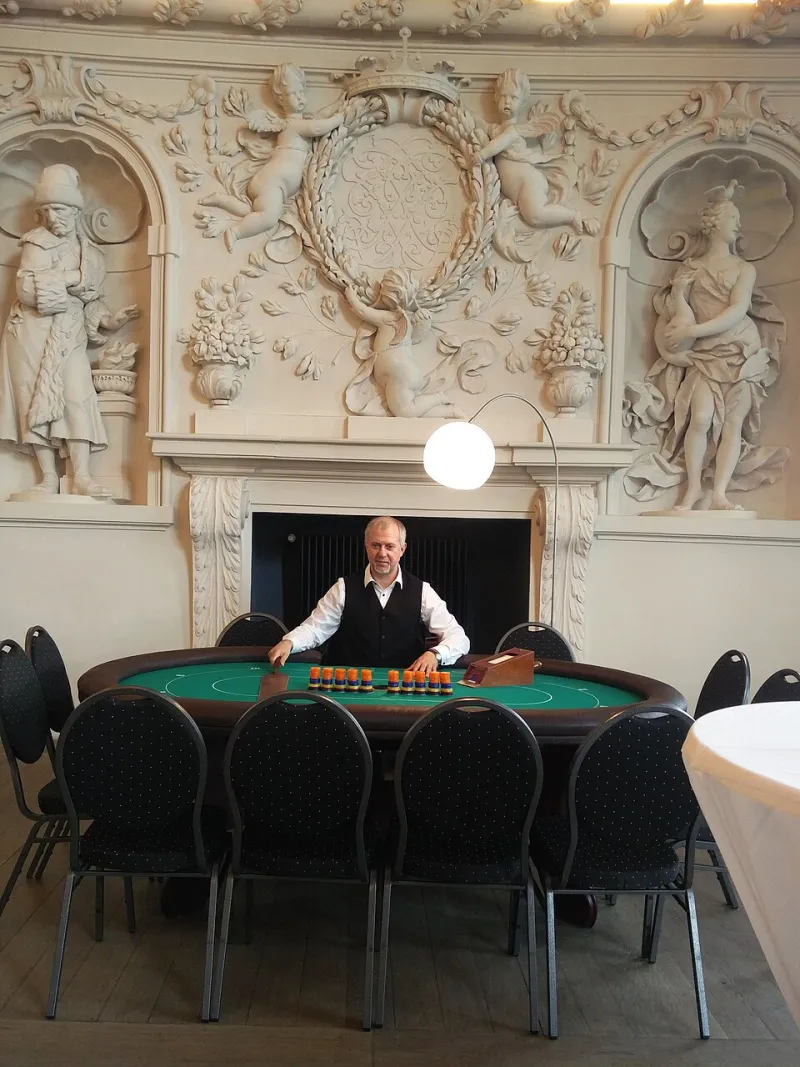
Photo: UdoPaul, CC BY-SA 4.0, via Wikimedia Commons
Walk into any baccarat pit in Las Vegas, Atlantic City, or any tribal casino across the United States, and you will find the Tie bet waiting for you — prominently displayed, boldly priced, and remarkably persistent. It promises an 8-to-1 return on a game where the two main outcomes are essentially coin-flip propositions. For a casual player, that payout sounds almost too good to pass up.
It is, in fact, precisely that.
The Tie bet is one of the most mathematically punishing wagers available at any standard casino table game. Understanding why requires a closer look at the numbers — not the payout number printed on the felt, but the ones that determine your long-term results.
Breaking Down the House Edge
In baccarat, every outcome is governed by a fixed set of probabilities derived from the game's drawing rules. Over a standard eight-deck shoe, the approximate probabilities shake out as follows:
- Banker wins: roughly 45.86% of hands
- Player wins: roughly 44.62% of hands
- Tie: roughly 9.52% of hands
With a Tie occurring less than one in ten hands, an 8-to-1 payout might seem reasonable at first glance. But fair compensation for that probability would require a payout closer to 9.47-to-1. The casino pays 8-to-1, which creates a gap — and that gap is where the house edge lives.
The result is a house edge of approximately 14.36% on the Tie bet in an eight-deck game. Some single-deck or six-deck variants carry a slightly different figure, but no standard baccarat game offers a Tie bet with a house edge below 4%, and most land comfortably above 14%.
To put that in perspective: the Banker bet carries a house edge of roughly 1.06% after the standard 5% commission. The Player bet comes in at approximately 1.24%. The Tie bet is not a slightly worse option — it is operating in an entirely different category of risk.
What That Number Means in Real Dollars
House edge percentages can feel abstract, so consider a concrete scenario. Suppose you are playing baccarat at a $25 minimum table and you wager on the Tie bet for every hand over a two-hour session, completing roughly 60 hands.
Your total action across that session: $1,500.
Applied against a 14.36% house edge, your expected loss over that session is approximately $215. Contrast that with the same $1,500 in action placed exclusively on the Banker bet, where the expected loss drops to roughly $16.
That difference — nearly $200 — represents the true cost of the Tie bet's appeal. Over a weekend trip to Las Vegas, or a month of regular sessions at a local card room, those figures compound significantly.
Why Experienced Players Leave It Alone
Among players who have studied baccarat seriously, the Tie bet receives a consistent verdict: avoid it entirely. This is not superstition or conservative instinct. It is a conclusion derived from the same mathematical framework that governs every other decision at the table.
Seasoned baccarat players tend to operate within a narrow band of acceptable house edges. The Banker bet, despite its commission, remains the most defensible wager in the game on a pure math basis. The Player bet is a reasonable alternative when commission structures or table conditions make it preferable. Both bets keep the house advantage below 1.25%, which allows skilled bankroll management to extend sessions meaningfully.
The Tie bet, by contrast, erodes a bankroll at a rate that no betting system or streak management technique can offset. Even the most aggressive positive-progression strategies — systems designed to capitalize on winning runs — cannot overcome a starting disadvantage of more than 14 cents on every dollar wagered.
The Psychology Behind the Temptation
If the math is this clear, why does the Tie bet remain so popular? The answer involves several well-documented psychological tendencies that casinos understand — and quietly rely upon.
The payout illusion. An 8-to-1 return is visually and emotionally striking. In a game where most outcomes pay even money, the prospect of multiplying a bet eightfold activates a reward response that temporarily overrides analytical thinking. This is sometimes called "payout anchoring" — the payout number becomes the mental reference point rather than the probability behind it.
Recency bias. When a Tie hand occurs — particularly after a long dry stretch — players remember it vividly. The rarity of the event makes it feel significant, almost due. In reality, each hand is an independent event. The game has no memory, and a Tie is no more likely after ten non-Tie hands than it was at the start of the shoe.
The near-miss effect. Hands that end very close in point totals — a 6 versus a 6, for instance, resolved by a drawing rule — can create the sensation that a Tie almost happened. Players who experience several near-misses in succession sometimes interpret this as evidence that a Tie is imminent. It is not.
Low-stakes justification. Many players treat the Tie bet as a small side wager placed alongside their primary Banker or Player bet. "It's only $5," the reasoning goes. But a $5 Tie bet placed on every hand across a full shoe represents meaningful expected loss when aggregated over time — and the habit, once formed, tends to scale upward.
A Smarter Framework for Baccarat Decision-Making
The most effective approach to baccarat involves concentrating your wagering activity where the mathematical environment is most favorable. That means building your strategy around Banker and Player bets, understanding the commission structures at your specific table, and treating the Tie bet as a line item to be deliberately excluded from your session plan.
This does not mean baccarat becomes a guaranteed winning proposition — no casino game is. But it does mean your results over time will reflect a house edge that is manageable rather than one that virtually guarantees rapid bankroll erosion.
At Baccarat 168 Academy, the foundational principle is straightforward: master the math before you master the table. The Tie bet fails that standard comprehensively. Its payout is seductive precisely because it is designed to be. Recognizing that design for what it is — a mathematical trap dressed in attractive packaging — is one of the clearest signs of a player who has moved from casual participation to genuine strategic understanding.
Leave the Tie bet where it belongs: on the felt, uncollected.