Why the Last Ten Hands Tell You Nothing: Breaking the Streak Illusion in Baccarat
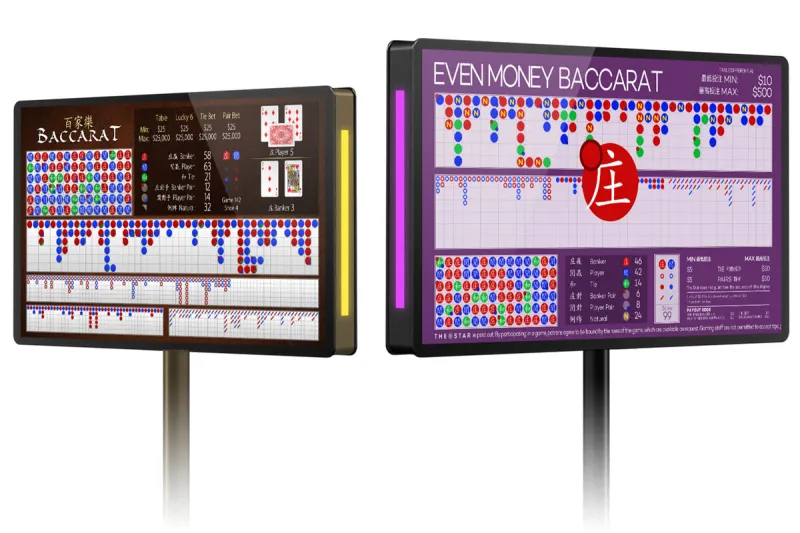
Photo: baccarat casino scoreboard electronic display table, via www.cammegh.com
The Scoreboard That Lies to You
Walk into any baccarat room in Las Vegas, Atlantic City, or a tribal casino in Connecticut, and you will find the same familiar display mounted above the felt: the electronic scoreboard tracking the last twenty, thirty, or even fifty outcomes. Banker wins glow in blue. Player wins appear in red. Ties and pairs are marked in their own columns. Casinos invest in this infrastructure deliberately, and it is worth pausing to ask why.
The scoreboard does not help you win. It helps you feel as though you can.
That distinction matters enormously, because the entire architecture of streak-based betting — the idea that a "cold banker" is due to lose or a "hot player" run will continue — rests on a foundational misunderstanding of how probability works in an independently shuffled card game.
What Independent Events Actually Mean
In mathematics, two events are considered independent when the outcome of the first has no bearing on the probability of the second. A standard baccarat shoe is reshuffled between shoes, and while card removal within a single shoe creates slight compositional changes, those changes are marginal and do not produce the dramatic predictive patterns that streak-chasers believe they are reading.
Each hand, for practical purposes, carries approximately the same underlying probabilities: roughly 45.86 percent for Banker, 44.62 percent for Player, and 9.52 percent for Tie. These figures do not shift because Banker won the last six hands in a row. The cards have no memory. The shoe has no loyalty.
This is not a philosophical point — it is a statistical one, and it has been confirmed repeatedly through analysis of millions of live baccarat hands across commercial casinos. Researchers studying large datasets of recorded outcomes consistently find that the distribution of streaks in baccarat aligns almost precisely with what random probability would predict. There is no hidden momentum. There is no thermal state to a table.
The Gambler's Fallacy and Its Expensive Cousin
Behavioral economists have a name for the belief that past random outcomes influence future ones: the Gambler's Fallacy. It is one of the most thoroughly documented cognitive biases in the academic literature on decision-making, and baccarat players are particularly susceptible to it because the game's near-even odds create the illusion of balance waiting to be restored.
If Banker has won eight consecutive hands, a player experiencing the Gambler's Fallacy feels that Player is "overdue." The logic seems intuitive — surely things must even out. But "evening out" happens across tens of thousands of trials, not within a single shoe. The law of large numbers describes convergence over enormous sample sizes, not correction within the next few hands.
There is also an opposite trap, sometimes called the Hot Hand Fallacy, which leads players to chase streaks rather than bet against them. A Player run of five or six hands can feel like momentum, as though some force has tilted the game temporarily in one direction. Players who follow this logic increase their bets expecting the run to continue. The mathematics assign that expectation no more validity than its opposite.
Both errors are costly. Both emerge from the same root cause: treating a scoreboard as a predictive instrument when it is, at best, a historical record.
Why Casinos Are Happy to Encourage Pattern-Reading
It is instructive to consider the casino's perspective. The scoreboard, the trend cards that some venues distribute to players, the "road" tracking systems popular in Asian baccarat culture and increasingly common in US high-limit rooms — none of these tools reduce the house edge. They increase player engagement and extend session duration.
A player who believes they are reading the table is a player who feels in control. A player who feels in control tends to bet more confidently, stay longer, and rationalize losses as misread patterns rather than as the natural variance of a negative-expectation game. The house benefits from the illusion of pattern without bearing any of its costs.
This is not a conspiracy. It is simply good business design. Understanding the incentive structure helps you evaluate the tools being offered to you.
Variance Is Not a Signal
One of the most important concepts for any serious baccarat student to internalize is the difference between variance and signal. In any random process, clustering is not just possible — it is mathematically expected. If you flip a fair coin one thousand times, you will almost certainly encounter runs of six, seven, or even eight consecutive heads. Those runs do not indicate a biased coin. They are exactly what randomness looks like.
Baccarat streaks are variance. A run of seven Banker wins in a row is not evidence of a hot table or a tilted shoe. It is a statistically ordinary event that will appear in any sufficiently long series of baccarat outcomes. Treating it as a signal — and adjusting your betting strategy in response — introduces decision-making noise into a process that does not reward it.
The disciplined player does not ask "what has been happening?" The disciplined player asks "what is the expected value of this bet, and can I afford the variance associated with it?"
A Practical Framework for Streak-Resistant Play
Recognizing the streak illusion intellectually is one thing. Resisting it at the table, while a scoreboard is flashing and neighboring players are murmuring about a cold banker, is another challenge entirely.
A few practical principles can help.
First, decide on your betting unit and session bankroll before you sit down, and commit to those parameters regardless of what the scoreboard shows. If your strategy is to bet Banker consistently — which remains the lowest-house-edge standard wager at approximately 1.06 percent — execute that strategy without modification based on recent outcomes.
Second, set a personal rule against increasing your bet size in response to a perceived streak. Whether you feel the urge to chase a run or bet against it, both impulses come from the same flawed premise. Flat betting or a predetermined progression that is not reactive to outcomes removes that variable from your decision-making.
Third, use the scoreboard for what it actually is: a record of what has already happened, with no predictive value. If viewing it consistently triggers pattern-seeking behavior, consider simply not consulting it.
The Edge Belongs to the House — Don't Give It More
Baccarat is a negative-expectation game. That is the baseline reality every informed player accepts before placing a wager. The house edge cannot be eliminated, but it can be managed. Choosing the Banker bet over the Tie, managing your bankroll with discipline, and playing within a session structure that limits exposure — these are the levers available to you.
Streak-chasing is not a lever. It is a mechanism for converting variance into additional losses by increasing bet sizes at moments when you feel most certain — and certainty in a random game is a feeling, not a fact.
The scoreboard will always be there. The discipline to ignore its false promises is what separates a student of the game from a player who simply hopes.