Your First Ten Minutes at a Vegas Baccarat Table: A Judgment-Free Walkthrough
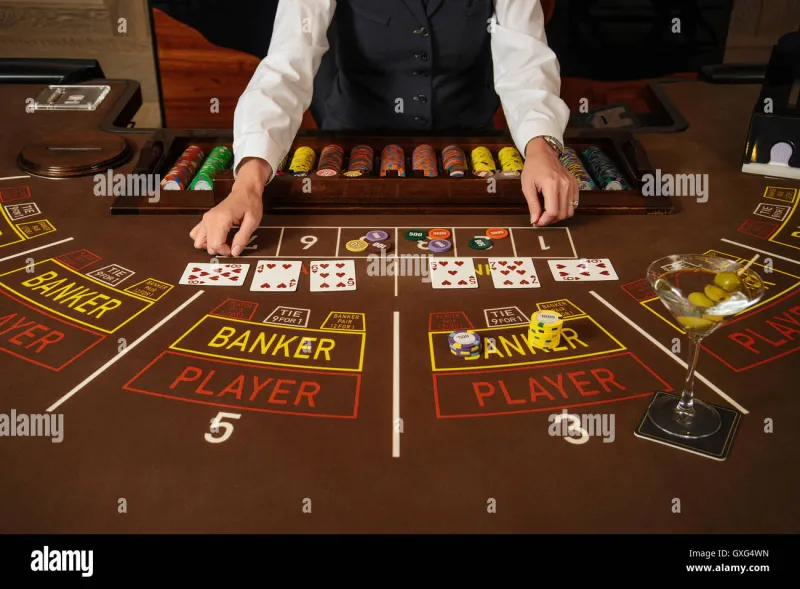
Photo: beginner player learning baccarat Las Vegas casino table dealer, via c8.alamy.com
Every Vegas trip produces the same scene: a group of friends walks past the baccarat pit, someone slows down, and someone else says, "That's the game with the tuxedos, right? We can't play that." So they head to the blackjack tables, where the house edge against them is two to three times worse.
Here's the secret the velvet ropes hide: baccarat is one of the easiest games on the casino floor. You make one decision — Banker, Player, or Tie — and the dealer handles everything else. What actually keeps newcomers away is not knowing the choreography. This guide fixes that.
Before You Approach
You don't need a bankroll of any particular size to learn baccarat. Most Las Vegas mini-baccarat tables open at $10 to $25, and off-Strip and downtown properties regularly go lower. Bring cash you've already budgeted for entertainment and buy in at the table.
One practical note: mini-baccarat, the version with 7 seats and a dealer who deals all the cards, is where virtually every American learns the game. The big table version — the one in the movies, where players take turns dealing — is theater. Start small.
The Walk-Up: What to Actually Do
Approach any open seat and place your cash on the layout. Never hand money directly to the dealer — that's a rule across the entire casino, and dealers appreciate players who know it. The dealer will count it and push you chips.
Before the next hand begins, put a chip or two in the area marked Player or Banker. That's it. That's the whole game. If you're unsure the bet registered, ask. Dealers answer beginner questions constantly and without judgment; what they can't do is advise you which bet to make.
Understanding the Dealer and the Scoreboard
In mini-baccarat, the dealer draws and reveals every card according to fixed rules. You never touch the cards, calculate totals, or signal for a hit. Both sides aim for a total closest to nine; face cards and tens count as zero, and if a total goes over nine, you drop the first digit. A 7 and a 6 make 13, which counts as 3. The dealer knows all of this. You don't need to.
The electronic scoreboards above the table display the history of previous hands — rows of red circles for Player wins, blue for Banker, green for ties. These are the famous "roadmaps." They're fascinating to watch and completely non-predictive; each hand is an independent event from a shuffled shoe. Treat the scoreboard as scenery, not a signal.
The Three Bets, Honestly Explained
- Banker wins slightly more often than it loses and carries a 5% commission, producing a house edge of about 1.06%. It is, mathematically, the best bet on the table.
- Player pays even money with no commission and a house edge of about 1.24%. Perfectly reasonable.
- Tie pays 8-to-1 in most US casinos, and the house edge balloons to over 14%. It is the most attractive-looking and worst-value wager in the room.
If you remember nothing else from your first session: bet Banker or Player, and skip the Tie.
Newcomer Mistakes to Sidestep
The most common first-timer errors have nothing to do with strategy. New players sometimes try to pick up the cards — in mini-baccarat you never touch them. Some wait for the scoreboard to "turn" before betting, slowing the game and drawing gentle impatience from the table. Others treat a streak of Banker wins as a system to ride for ten straight bets. And a surprising number tip the dealer after a loss out of sympathy; tipping is fine, but it's not a strategy.
The Unwritten Etiquette
A few customs make you look like a regular within one shoe:
- Don't join mid-hand; wait for the current one to finish.
- Keep phones off the felt in most rooms.
- Let the dealer handle all cards and chips movement — push your bet in front of you when you want it placed, never toss chips across the layout.
- If you hit a nice win, tipping the dealer is appreciated but entirely optional.
- Complaining loudly about "the shoe" marks you instantly as a newcomer. Everyone at the table is playing the same shoe.
Your First Session, Simplified
Buy in for an amount you're happy to spend on entertainment. Bet Banker, in units of 1% to 2% of your buy-in. Watch a few hands before joining if you like — nobody will mind. When your entertainment budget or your attention runs out, cash out by pushing your chips toward the dealer and saying "color out" or simply "cash out, please."
That's the entire experience. No tuxedo, no secret handshake, no embarrassment. The most intimidating thing about baccarat turns out to be how little there is to be intimidated by — and the sooner you sit down, the sooner you can start playing the best-odds game in the American casino with genuine confidence.