The True Cost of Side Bets: A Rigorous Guide to Baccarat's Most Tempting Wagers
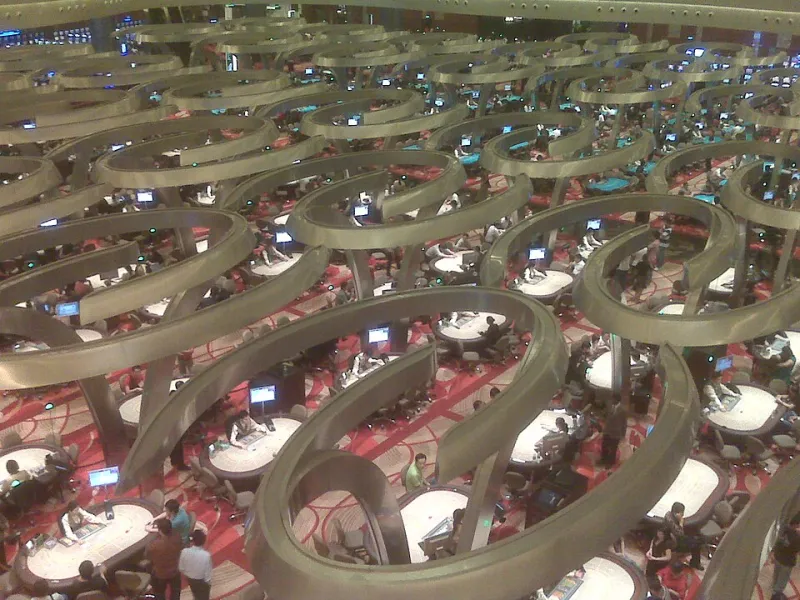
Photo: hj_west from USA., CC BY-SA 2.0, via Wikimedia Commons
Why Side Bets Exist and Who They Serve
Every baccarat side bet on the market today was designed by a casino game developer, reviewed by a gaming mathematician, and approved by a state gaming commission before it reached the felt. That approval process confirms only that the bet is fair — meaning it pays according to its stated odds. It does not confirm that those odds represent good value for the player.
Side bets proliferate because they generate additional hold for the casino without requiring additional table space or dealers. A single hand of baccarat can now accommodate three, four, or even five simultaneous wagering opportunities, each with its own payout structure and house edge. For the property, this is efficient revenue generation. For the player, it requires careful evaluation.
Across US gaming jurisdictions — from the major commercial floors in Nevada and New Jersey to the expanding tribal casino markets in states like Washington, Oklahoma, and Michigan — the side bet landscape varies considerably. This guide focuses on the bets you are most likely to encounter and the numbers you need to understand before placing a chip.
Dragon Bonus: The Most Widely Available Side Bet
The Dragon Bonus is arguably the most common baccarat side bet in American casinos. It is offered in two versions — one for the Banker hand and one for the Player hand — and it pays based on whether your chosen side wins by a margin of four or more points, or wins with a natural (an eight or nine on the initial two cards).
Payout schedules vary by casino, but a typical Dragon Bonus table looks like this: a natural win pays 1:1, a non-natural win by nine points pays 30:1, by eight pays 10:1, by seven pays 6:1, by six pays 4:1, by five pays 2:1, and by four pays 1:1. Ties push.
The house edge on the Dragon Bonus Player bet typically runs between 2.65 and 3.7 percent depending on the specific payout schedule in use at a given property. The Dragon Bonus Banker bet tends to carry a slightly higher edge, often in the range of 9.4 percent, because the Banker hand wins by large margins less frequently after the drawing rules are applied. If you are going to engage with this side bet at all, the Player version is the more defensible choice — though neither approaches the value of a standard Banker wager.
Rating: Moderate-risk. The Player version is the only version worth occasional consideration.
Panda 8: A High-Volatility Trap
The Panda 8 side bet, found primarily in casinos using the EZ Baccarat variant (where winning Banker bets on a three-card total of seven push rather than pay), rewards a specific outcome: the Player hand winning with a three-card total of eight. This event is rare, which is why the bet typically pays 25:1.
Rarity and large payouts create the psychological appeal. The mathematical reality is less attractive. The house edge on Panda 8 is generally calculated at approximately 10.2 percent. To put that in context, a standard Tie bet — already widely regarded as one of the worst wagers at the baccarat table — carries a house edge of around 14.4 percent. Panda 8 is considerably better than a Tie bet, but it is still surrendering more than ten cents of every dollar wagered to the house in expected value.
Players who enjoy EZ Baccarat's removal of the Banker commission may find the overall format appealing, but Panda 8 should be treated as entertainment spending with a defined budget, not as a strategic component of a session.
Rating: High-risk. Treat as recreational, not strategic.
Perfect Pair and Either Pair: Understanding Pair Bets
Pair side bets are among the simplest and most universally offered in US baccarat rooms. The Player Pair and Banker Pair bets win when the first two cards dealt to the respective hand form a matching pair. The Either Pair bet wins if either hand produces a pair.
A Perfect Pair bet — available in some variants — requires not just a rank match but a suit match as well, and typically pays 25:1. A standard (non-perfect) pair bet generally pays 11:1.
The house edge on a standard Player Pair or Banker Pair bet is approximately 10.4 percent in an eight-deck shoe. Either Pair, despite the added flexibility of winning on either hand's pair, carries a similar edge in the range of 10 to 11 percent. Perfect Pair bets, given their stricter requirements, often carry edges exceeding 13 percent.
Pair bets are visually simple and emotionally satisfying when they hit, which explains their popularity on busy Friday nights in Las Vegas. Their mathematical profile does not support regular inclusion in a disciplined wagering strategy.
Rating: High-risk. Suitable only for recreational players with a clearly defined side-bet budget.
Lucky 6: A Regional Variant Worth Knowing
The Lucky 6 side bet, increasingly common in California card rooms and in some Nevada properties offering commission-free baccarat variants, pays when the Banker hand wins with a total of exactly six. Payouts vary — a two-card Lucky 6 typically pays 12:1 while a three-card Lucky 6 pays 20:1 in many formats.
The house edge on Lucky 6 generally falls between 10 and 13 percent depending on the payout structure and shoe composition. Some operators have introduced this bet as part of a package to offset the removal of the standard five-percent Banker commission, so it is worth evaluating the full table rules before assuming the commission-free format is automatically more player-friendly.
Rating: High-risk. Evaluate in the context of overall table rules before placing.
A Comparative Ranking of Common US Side Bets
For players who want a quick reference before sitting down, here is a summary ranking from most to least player-friendly based on typical house edge ranges:
- Dragon Bonus (Player version) — House edge approximately 2.65–3.7%. The most defensible side bet option if you choose to engage.
- Dragon Bonus (Banker version) — House edge approximately 9.4%. Significantly worse than the Player version.
- Panda 8 — House edge approximately 10.2%. High variance, high cost.
- Player Pair / Banker Pair — House edge approximately 10.4%. Popular but expensive over time.
- Lucky 6 — House edge approximately 10–13%. Evaluate carefully within the context of table rules.
- Either Pair — House edge approximately 10–11%. Similar to individual pair bets.
- Perfect Pair — House edge often exceeding 13%. One of the worst-value bets in standard baccarat.
For reference, the standard Banker bet carries a house edge of approximately 1.06 percent after the five-percent commission. Even the most favorable side bet on this list is more than twice as expensive as a Banker wager.
When — If Ever — Should You Place a Side Bet?
This is the practical question, and it deserves an honest answer rather than a blanket prohibition.
If your session goal is purely to minimize expected losses while maximizing time at the table, the answer is straightforward: avoid all side bets. Stick to Banker, manage your bankroll, and accept that baccarat is a low-edge, low-volatility experience when played correctly.
If you are playing recreationally, have a fixed entertainment budget, and find that an occasional Dragon Bonus wager adds to your enjoyment of the session, allocating a small, predetermined portion of your buy-in to that bet is not irrational — as long as you do so with full awareness of the cost.
The error is not in occasionally placing a side bet. The error is in treating side bets as a strategic component of your game, increasing them when you feel lucky, chasing losses through them, or failing to account for their edge when evaluating your session performance.
The Bottom Line on Side Bets
Side bets are designed to be appealing. Their payout structures are calibrated to create memorable wins at a frequency that sustains interest. The casino's margin on each of them is substantially higher than on the core baccarat wagers, and that margin is not an accident — it is the point.
A well-informed baccarat player treats side bets the way a disciplined investor treats speculative assets: with a clear allocation limit, a realistic understanding of expected return, and no illusion that excitement is the same thing as edge.